
The Cost of Uncertainty: Are We Giving In Before We Have To?
Keynotes Addressed by John Morrison
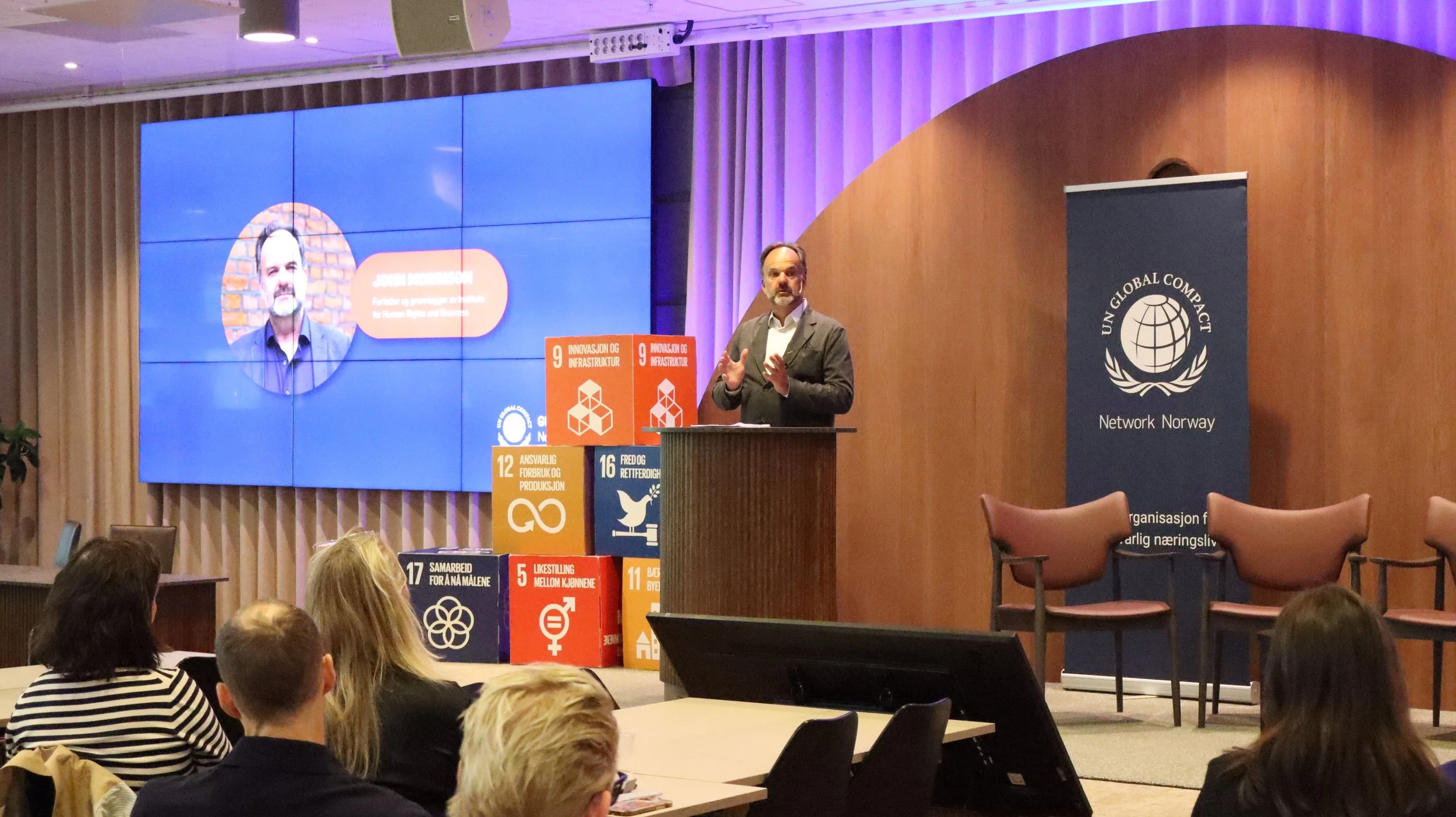
Medlemskonferanse, Oslo, 4. mai 2026
— Congratulations on today’s event. Its focus is very timely and very much needed.
There is a concept I want to place at the centre of today's conversation, and it comes not from business literature, but from political history.
As you heard in Oda’s speech, the scholar Timothy Snyder, writing about the erosion of democratic institutions in interwar Europe, observed that the most consequential changes were rarely produced by new laws or executive orders. They were produced by the anticipatory obedience of ordinary institutions - businesses, courts, universities - that began adjusting to what they assumed was coming. He called it accommodation in advance of demand.
One hundred years ago, the largest company in Europe was I.G. Farben. In the late 1920s it was seen as a role model company, with a relatively diverse board and more than one Nobel Prize winning chemist amongst its ranks. Over the 15 years that followed, this company was to descend to levels of complicity that included the use of slave labour at the Auschwitz concentration camp and the development of the gas that murdered over a million men, women and children, amongst the millions killed in such camps.
The surviving board minutes of I.G. Farben during this period were used in evidence during the Nuremberg trials and demonstrate an egregious example of pre-emptive accommodation to a ‘new reality’. This case, amongst others, became the basis of corporate complicity under international law, reflected in Second Principle of The United Nations Global Compact that all of you here today are committed to.
I raise this not to reach for a dramatic historical analogy or moral equivalency. I raise it because the mechanism is almost an instinctive one, which we have seen many times since. Like the frog in the slowly heating pan of water, it is easier to take a little more heat than to jump out. I think something very like it is operating across international business right now.
The opportunity of now
The United Nations Global Compact has been of the first comprehensive frameworks on sustainability. Launched in 2000, with 9 principles at first and then 10. It did not catch everything, but was long before ESG, Planetary Boundaries or Doughnut economics. Over the past 25 years, the Global Compact has watched the tide of sustainability turn more than once. Remember the pushback against some of the more philanthropic and arbitrary elements of ‘Corporate Social Responsibility’ we saw after the 2008-9 Financial Crisis. The move to frameworks such as ‘Shared Value’ and then John Ruggie’s Protect, Respect, Remedy framework which now also underpins how we think about this at the OECD, European Union, but also in much national legislation, including Norway. Each of these steps has brought sustainability closer to materiality and the core business of business.
But the current challenge is perhaps the most significant yet and reminds us that significant arbitrage still exists between intent and reality.
Let’s start by taking a look around. BP has lifted its annual oil and gas spend by around 20 percent, slashed its renewables budget from over five billion dollars a year to between one and two billion, and scrapped its planned production decline. Shell abandoned its 2035 carbon intensity target. The six largest US banks – including JPMorgan Chase, Bank of America, Goldman Sachs - withdrew from the UN-backed Net-Zero Banking Alliance earlier this year. BlackRock and Vanguard exited the Net-Zero Asset Managers initiative.
The retreat is real, it is wide. In my new book – Remaking Sustainability – I call this ‘shorting sustainability’. There are real short-term incentives for some governments and some businesses to retreat on sustainability at the moment.
But the question I want to ask - and it is the question I want us to sit with throughout this morning - is: how much of it is necessary? How much of it is actually beneficial to the wider interests of business? And how much of it is anticipatory? In other words, to what extent are we all complicit in the pushback against sustainability and human rights within the business environment and beyond?
The Lesson of Institutions Under Pressure
To sharpen the question, consider what has happened in American universities when pressure came for their values from a very different direction.
Harvard sued the US government administration in April 2025 to block a 2.7 billion dollar funding freeze - and won a court order restoring the funds. Over 180 institutions publicly denounced what they called unprecedented government overreach into higher education. A group including MIT, Penn, Dartmouth, Virginia, and USC rejected outright a White House compact that would have tied federal funding to conditions including the redefinition of gender and caps on international students. Yes, some universities settled. Columbia paid 221 million dollars to resolve an investigation. Others negotiated. But across the sector as a whole, the response was largely one of organised resistance - through courts, through collective statements, through the public rejection of terms designed to reshape institutional behaviour.
Now compare that with what we see in corporate sustainability. The same political environment. The same pressure. Very different responses.
The difference, I think, comes down to what institutions believe is a condition of their existence - versus what they believe is a strategy. Universities held firm because academic freedom is not their communication strategy. It is their operating premise. The moment you compromise it, you are no longer what you claimed to be. For many companies, sustainability has been a strategy. And strategies flex under pressure in ways that conditions do not.
This is not a comfortable observation. It implies that much of the retreat we are seeing was latent - waiting for the right pressure to reveal that commitments were never embedded deeply enough to be structural. But it is also, I think, the most useful thing we can say right now. Because it tells us what we need to change, and where the work actually lies.
It is worth noting too that this is not simply a story about American companies responding to American politics. We are seeing similar dynamics in Europe - large multinationals quietly recalibrating their supply chain due diligence programmes in advance of the revised CSDDD scope, asset managers softening their engagement postures ahead of regulatory uncertainty, boards deciding this is not the moment to push hard on human rights disclosures. None of that is being driven by Washington. It is being driven by an internal calculation about risk, optionality, and what can be quietly walked back without being noticed. That is anticipatory obedience in its most recognisable form.
Naming What Is Actually Happening
I have been working in this space since the mid 1990s. When I began, sustainability felt genuinely marginal. It still felt that way when Al Gore's Inconvenient Truth came out in 2006. And yet, if I look at where we are today, something remarkable has happened. Sustainability has become an orthodoxy.
Not a delivered reality - implementation has an enormous way to go, and I will come to that. But an organising idea so pervasive that even its opponents define themselves in relation to it. Of the executive orders that came from Washington at the start of 2025, 70 percent were designed to reduce or prevent some form of environmental or social action. The European Parliament's June 2024 elections saw green party seats fall by a quarter, while climate-sceptic parties surged. You don't legislate against things that don't matter. The backlash is, in a perverse way, a measure of how far we have come.
But here is where I have to be honest - with you, and with myself. A significant part of our current vulnerability was created from within.
There is what I would call a sustainability bubble: a proliferation of confusing acronyms, overstated claims, and performative behaviour that those of us in this field did not challenge nearly enough, nearly soon enough. Take ESG. In the United States since 2021, there have been over 480 state-level legislative proposals to block ESG investments, with more than 50 laws enacted. But the critique is not only American, and it does not come only from the right. From within our own field, serious analysts have argued that in trying to be all things to all people - a tool for investors, a legitimacy device for CEOs, a regulatory instrument for governments – ESG has ended up serving none of those purposes well. It has reduced the complexity of sustainability to a measurement exercise and handed an easy target to anyone who wanted to dismiss the entire agenda as ideological rather than operational.
For companies operating across multiple jurisdictions - as many of the people in this room do - the regulatory picture is more differentiated than the current mood music suggests. The CSRD, the CSDDD, mandatory human rights due diligence legislation in France, Germany, and now multiple other jurisdictions, ISSB standards becoming baseline expectations across more than 20 major economies: these are real, consequential, and moving in one direction. The US deregulatory turn is real, but it does not define the global regulatory trajectory. Conflating Washington with the world is one of the most common - and most costly - errors of anticipatory retreat.
So when I look at the norm drift we are observing - climate plans quietly extended, human rights due diligence deprioritised, anti-corruption programmes scaled back - I see three things happening simultaneously.
First: genuine opportunism. Companies and political actors exploiting uncertainty to exit commitments they never fully intended to honour.
Second: anticipatory obedience. Organisations adjusting not to rules that have changed, but to futures they are projecting - sometimes accurately, often not.
Third: a legitimate reckoning with commitments that were overclaimed and underdelivered. The UN reports we are on course to meet just 35 percent of SDG milestones. The gap between stated ambition and measurable outcome is wide - and it has been weaponised by those who want to short the entire agenda. All three dynamics are real, and all three are happening at once. Our responses need to be precise enough to distinguish between them, because the right answer to each is very different.
The Twin Failures: Greenwashing and Greenhushing
I want to name two patterns that I think of as the evil twins of performative sustainability - and I believe they are more important for understanding the current moment than almost any external political factor.
Greenwashing created the bubble. The false and misleading claims, the performative speeches, the net-zero targets that bore little relationship to capital allocation or operational reality. BP's 2020 commitment to reduce its oil and gas production by 40 percent by 2030 is now a relic. Its incoming CEO's first message to staff on day one was 'consistency' - a reassurance that the hydrocarbon-first reset will not be reversed again. The contrast with the commitments made just five years ago could not be starker. But BP is not an outlier. It is an illustration of how thin the operational embedding of those earlier commitments actually was.
Greenhushing contributed to the demise of the bubble - by obscuring what was really going on and removing the pressure that honest disclosure would have created. Consider the modern slavery statements issued by companies in the UK over the past ten years under the Modern Slavery Act. With a notable few exceptions, they have been acts of minimalism - the legal floor, not a genuine commitment to transparency. The underlying logic was simple: there was little public or political reward for honesty about supply chain risk. So honesty was withheld. For companies sourcing from complex global supply chains - fishing fleets in the Pacific, garment factories in South Asia, electronics components from conflict-affected regions - this is not abstract. The risk is real. The question is whether you surface it or suppress it. In an environment where scrutiny now feels lower, the temptation to hush further is acute. That is exactly the dynamic we need to interrupt, not accelerate.
On climate delivery: the credibility problem is not primarily one of ambition. It is one of delivery. Most high-carbon assets have not closed. Most planned transitions are, in practice, diversifications - new renewable capacity added while legacy coal, oil, and gas assets remain in place.
The Social Licence for Sustainability That Was Never Secured
There is a deeper problem underneath all of this, and it goes to the question of legitimacy.
The sustainability agenda currently lacks a genuine social licence for the scale of action it demands. Not because the science is wrong - I remain entirely clear on that. But because we have not consistently made the case in terms of benefits, costs, trade-offs, and equity that genuine consent requires. And we have barely begun to acknowledge that we need to.
Think about the political geography of the pushback. Farmer protests across India, France, Germany, the Netherlands, and beyond. Rural communities in North America and Australia voting heavily against climate action. Working-class voters in post-industrial regions of the United Kingdom, the United States, and Central Europe who feel that the transition agenda will cost them their livelihoods and that nobody in a position of authority has given them a credible answer about what comes next.
These are not manufactured grievances, though they are sometimes manipulated by those who exploit them. They reflect a real failure by the sustainability movement to speak honestly about costs, trade-offs, and who bears them. The just transition question - who pays for the energy transition, who loses jobs, whose community is transformed, and on what terms - was largely absent from the climate policy conversation for two decades. It appeared in the preamble to the Paris Agreement in 2015, but a formal work programme between state parties was not agreed until 2025. A reference in a preamble is not an answer.
The consequence is structural. Those opposing climate action have been far more effective at using place-based thinking and articulating people's local needs than those advocating for it. The sustainability professionals of our time are largely urban, highly educated, and internationally mobile. Many have never worked in the industries they are asking to transform. The gap in lived experience is not merely a communications problem. It has produced a genuine failure to understand what transitions actually cost at the human level - and therefore a genuine failure to build the consent that durable transitions require.
I want to be clear: this is not an argument for slowing down. It is an argument for doing the work we should have done twenty years ago. Building social licence means being specific about benefits. Honest about costs. Transparent about trade-offs. Genuinely accountable to the people most affected by the changes being asked of them. Not through communications strategies, but through operational commitment that communities can actually see and test. The organisations, and the governments, that invest in building that legitimacy will be more durable. The ones that rely on assertion and narrative alone will continue to be exposed when pressure arrives.
What Holding Firm Actually Requires
So what does holding firm look like in practice, for international businesses operating in this environment? Let me offer four things - each of them operational, not rhetorical.
First: distinguish between what has changed and what you are projecting. Much of what is driving the retreat is not a response to changes that have happened. It is a response to futures that organisations are modelling - and sometimes modelling inaccurately. The regulatory direction of travel on human rights due diligence, on climate disclosure, on anti-corruption - in Brussels, in major institutional investor frameworks, in the procurement standards of large public and private buyers - has not reversed. It has paused in some jurisdictions and accelerated in others. Before adjusting a commitment, the analytical question should be: what has actually changed? Not: what might change? Acting on the latter, at scale and in aggregate, is precisely how norm shifts happen without anyone explicitly choosing them. The irony is that organisations trying to manage risk by retreating are, collectively, creating the norm erosion they feared individually.
Second: be honest in your language. One of the patterns I observe - and that I have not always been immune to myself - is the use of neutral technical language to describe what are in fact value choices. 'Recalibrating' a target. 'Streamlining' a reporting framework. 'Refining' a due diligence process. These phrases do real work. They allow decisions to be made without being named. If a commitment is being weakened, name it as such, and then interrogate whether it should be. The discipline of honest language is not merely ethical. It is analytically necessary. It forces the real question into the open rather than allowing it to be resolved by accumulated euphemism. And it creates accountability: internally, with boards and investors, and externally, with the communities and workers who are watching.
Third: rebuild on operational ground. The companies that will hold firm through this period are not necessarily those with the strongest public commitments. They are the ones whose sustainability practices are embedded deeply enough in how they actually operate that retreat would be operationally disruptive - not merely reputationally uncomfortable. When capital allocation decisions explicitly price climate, nature, and social risk - even when it suppresses short-term returns - sustainability has moved from aspiration to infrastructure.
Fourth: take social licence seriously - operationally, not rhetorically. For businesses with global operations and complex supply chains, this means genuinely engaging workers, communities, and partners on the changes being asked of them - not managing the narrative around those changes. It means being specific about what a transition will mean for particular people in particular places. It means transparency about risk, accountability for outcomes, and effective remedy when things go wrong.
Conclusion: some thoughts for UN Global Compact members
To the UN Global Compact members in this room, let me close with some asks.
Refuse anticipatory obedience. Before adjusting any commitment, ask what has actually changed, not what you fear might. Distinguish the regulation that has paused from the regulation that is accelerating, and act on the difference.
Embed sustainability operationally, not rhetorically. The Ten Principles of the UNGC are not a communications framework. But the world has moved on and so must the Principles. They must be aligned with legislation, benchmarks and operational frameworks for sustainability that have emerged on technology, trade, finance, and value chains. If the UNGCs are not operational then they are just rhetorical and there is no room for sustainability rhetoric over the years ahead. But to be operational, the principles need refinement and alignment with the standards that have emerged over the last 25 years.
Sustainability of the future will be judged by its delivery and impact, and therefore it is a matter of concern that only one third of SGG milestones will be met by 2030. But now is the time to start thinking what will replace the SDGs – the work on this must start soon when the new UN Secretary General is in place. We know that whilst the 17 SDGs were comprehensive in terms of thematic coverage, they were much less clear in terms of application – on governance, accountability, due diligence, what partnerships should look like, and how multi-stakeholder approaches are so critical. The role of business was an afterthought, and if we have learned one thing from the Climate Action agenda, or the development of AI, is that society and environment cannot afford business to be an afterthought. Whatever replaces the SDGs – the responsibilities of business, as well as the potential leverage of business in terms of delivery, need to be hardwired from the start.
The recovery from the pushback will make us stronger. The new form of sustainability that will emerge will be operationally focused and impact oriented. Remaking sustainability happens in rooms like this today, by people prepared to name what is happening and refuse to accommodate it.
Thank you.