
Arrangementer
UN GCD Supply Chain Dialogue - Mining Sector in Southeast Asia
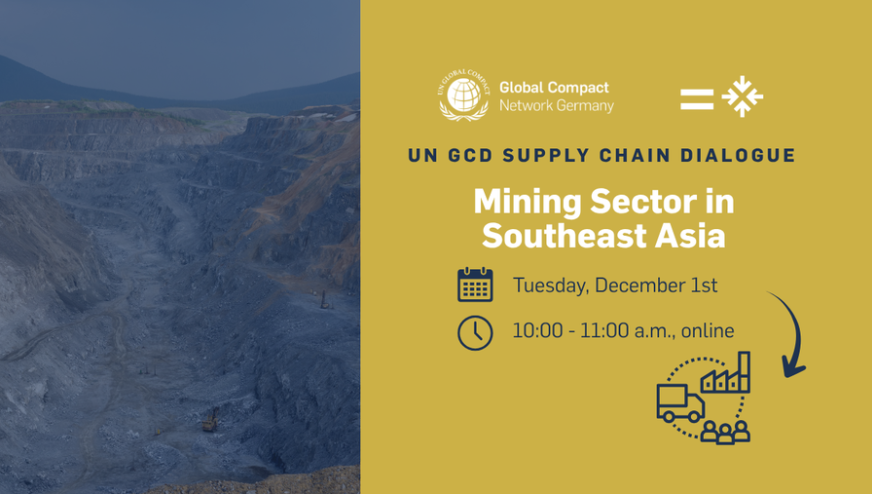
The UN GCD Supply Chain Dialogue 2026 brings together companies, suppliers, and rightsholder representatives to explore how human rights due diligence (HRDD) can become more effective, collaborative, and impactful.
The third session of the UN GCD Supply Chain Dialogue 2026 focuses on the mining and mineral sector in Asia, with a particular focus on Indonesia. It brings companies into dialogue with AEER – Aksi Ekologi & Emansipasi Rakyat, an Indonesian non-profit organisation working on environmental and energy issues in close connection with affected communities.
Drawing on its research-based advocacy and engagement with communities, financial institutions and policymakers, AEER will provide insights into the human rights and environmental impacts of mining and mineral supply chains. The discussion will explore how coal and nickel mining can affect local livelihoods, biodiversity, water resources, public health and the rights of affected communities – including in the context of the growing demand for critical minerals and low-carbon technologies.
Moving beyond a narrow focus on compliance, participants will examine how companies can identify and address impacts across complex mineral supply chains. The session will discuss meaningful engagement with rights-holders, responsible sourcing, corporate accountability and the role of human rights due diligence in supporting an ecologically just and socially fair transition.
Understanding Responsible Contracting - Session Three

The last webinar of the Responsible Procurement series centers around responsible contracting. It covers good practices for three main types of documents: general terms and conditions, codes of conduct, and purchasing contracts. At the core of the webinar will be the European Model Contracting Clauses. Overall, this webinar aims to enable companies to draft responsible policies and contracting clauses.
COP31 Debrief
Every year, the United Nations Framework Convention on Climate Change (UNFCCC) hosts its Conference of the Parties, or COP, to assess global progress on climate action and to unite stakeholders to work together on solutions.
With tens of thousands of participants and a multitude of sessions and agenda points, following and digesting the outcomes of COPs can be challenging.
On the heels of COP31 in Antalya, Türkiye, from 9 – 20 November 2026, the UN Global Compact Academy is proud to host the COP31 Debrief, a live webinar on 1 December 2026, providing expert context and nuance to the main headlines from COP31 and share priorities and opportunities for corporate action to drive progress in 2027.
Office Hours: Communication on Progress - Session three

Join the CoP team for a live Q&A office hours session, where they will walk through key requirements and share important updates for the 2026 Communication on Progress (CoP) reporting cycle.
The CoP is the primary reporting mechanism of the UN Global Compact and a mandatory annual requirement for all business participants. Participants are strongly encouraged to attend if they have questions about CoP requirements, reporting processes, or available support resources.
This session is also a great opportunity to learn more about the CoP Data Visualization Tools, available here.
NDE Session 6: Action Plan Presentation & Closing
Ready to turn equality from a value into a daily business practice?
The programme on non-discrimination and equality is an online programme designed to support businesses in advancing equality and inclusion across their operations. If your company is ready to take meaningful steps to identify, assess, and address discrimination-related risks, this programme will guide you through the process with practical tools, expert insights and peer exchange.
Through six expert-led sessions, peer learning opportunities, and individual work, you will gain a solid understanding of how to assess impact, prioritize action, and embed non-discrimination across the workplace, supply chains, and communities.
The application deadline has passed. If you or anyone in your company would still like to participate, please contact us at medlem@globalcompact.no
Building the Business Case: Making Sustainability a C-Suite Investment Priority

While many companies recognize the business case for sustainability, securing funding and leadership support remains a challenge. As companies plan for 2027, sustainability teams must demonstrate measurable business value, compete for limited budgets and make the case for investment in a way that resonates with finance and decision-makers.
To support you in making a stronger financial case for sustainability, the UN Global Compact Academy invites you to Building a Business Case: Making Sustainability an Investment Priority, taking place on 3 December 2026.
This 90-minute live session will bring together expert insights and real-world corporate perspectives to help you articulate the value of sustainability initiatives, understand what finance teams look for in investment proposals, and build a business case that secures buy-in.
ESG Regulatory Briefing

The regulatory frameworks governing corporate actions in the context of sustainability and corporate responsibility issues are evolving rapidly. After a long period mainly shaped by industry self-regulation, companies now face comprehensive expectations, detailed both in soft law standards and – increasingly – hard law.
The UN Global Compact Network Switzerland & Liechtenstein and other Global Compact Networks have mandated ECOFACT AG to support companies in responding to regulatory sustainability and corporate responsibility regulations. These quarterly briefings provide information related to actions that need to be taken today and in the near future to remain compliant and competitive.
Join us for the webinar during which you can expect to learn what the current regulatory trends and key EU and international regulatory developments are. The ESG Regulatory Briefings offer a concise, high-level overview of the fast-evolving regulatory landscape, flagging changes and supporting you in gaining an understanding of what needs to be prioritised.
Please note: while these briefings deliver a consistent, strategic view of the fast-evolving policy landscape, they are distinct from the UN Global Compact’s EU Sustainability Navigator sessions, which dive deeper into practical insights and policy context.
Language
This webinar will be conducted in English.
Measuring what matters: Driving integrity through monitoring, evaluation and continuous improvement

As expectations around business integrity continue to evolve, companies are increasingly required not only to implement anti-corruption ethics and compliance programmes, but also to demonstrate their effectiveness. Robust monitoring and evaluation can help organizations understand whether their programmes are achieving their intended objectives, identify areas for improvement, strengthen organizational culture, and support informed decision-making.
Drawing on the updated publication, An Anti-Corruption Ethics and Compliance Programme for Business: A Practical Guide (2026), this session will examine practical approaches to monitoring and evaluation, including the use of indicators, audits, surveys, and other tools to assess programme performance and company culture. The session will also explore how companies can apply structured evaluation frameworks to identify gaps and embed continuous improvement into their compliance systems.