Arrangementer
Nordic Nature Working Group
Invite-only peer forum for Nordic companies advancing their work on nature
The Nordic Nature Working Group brings together a small group of nature and biodiversity leads from Nordic companies that are already advancing their work on nature.
The group is designed as a closed forum for practical exchange and candid discussion on how to move from ambition to implementation — particularly across complex value chains.
Format
The group meets four times per year, primarily online. Sessions are held in English and discussions take place in a trusted setting under Chatham House Rule, within a small and curated group of companies.
Focus areas
Discussions focus on how to operationalise nature strategies in practice, including strategy and governance, target-setting and metrics, disclosure, and implementation across value chains.
Who is it for?
The Working Group is intended for nature and biodiversity leads, or equivalent senior roles, in companies that are already actively working on nature-related issues and are looking for a peer forum at an advanced level.
Participation
Participation is by invitation only.
If your company is actively working on nature-related issues and you are interested in joining, please contact us to explore participation: medlem@globalcompact.no
Learn more
Read more about the Nordic Nature Working Group here:
https://globalcompact.se/nordic-nature-working-group/

Nettverk for bærekraftsledere
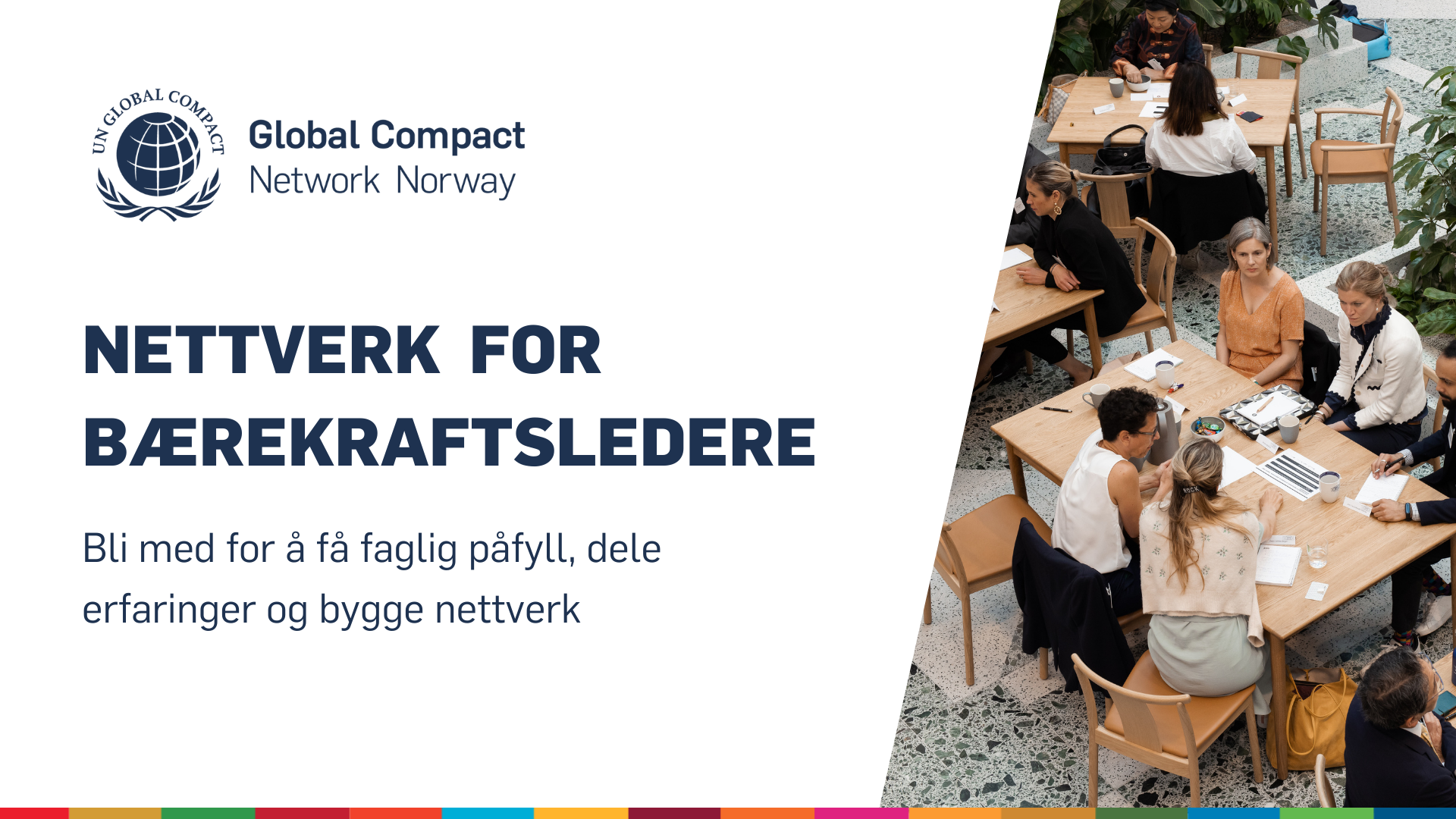
I 2026 starter vi Nettverk for bærekraftsledere. Nettverket vil samle ledere med ansvar for bærekraft på tvers av medlemsbedrifter i UN Global Compact Norge. Her får du et trygt rom for å dele erfaringer, få faglig påfyll og kunne sparre med andre med tilsvarende ansvarsområde som deg.
Gjennom digitale og fysiske samlinger vil deltakerne i nettverket få innsikt i aktuelle tema og god praksis, konkrete eksempler, praktiske verktøy og mulighet til å dele egne erfaringer og høre andres perspektiver.
Nettverket er gratis for alle bedriftsmedlemmer i UN Global Compact Norge. Som medlem i nettverket vil du få tilsendt mailer med informasjon om digitale og fysiske samlinger. I påmeldingen velger du hvilke lokasjonen som er aktuelle for deg.
Kommende samlinger:
16. november | Porsgrunn | Herøya Industripark
18. november | Tromsø | Drytech
The Clean Energy Advantage - Sustainability TrendsWatch
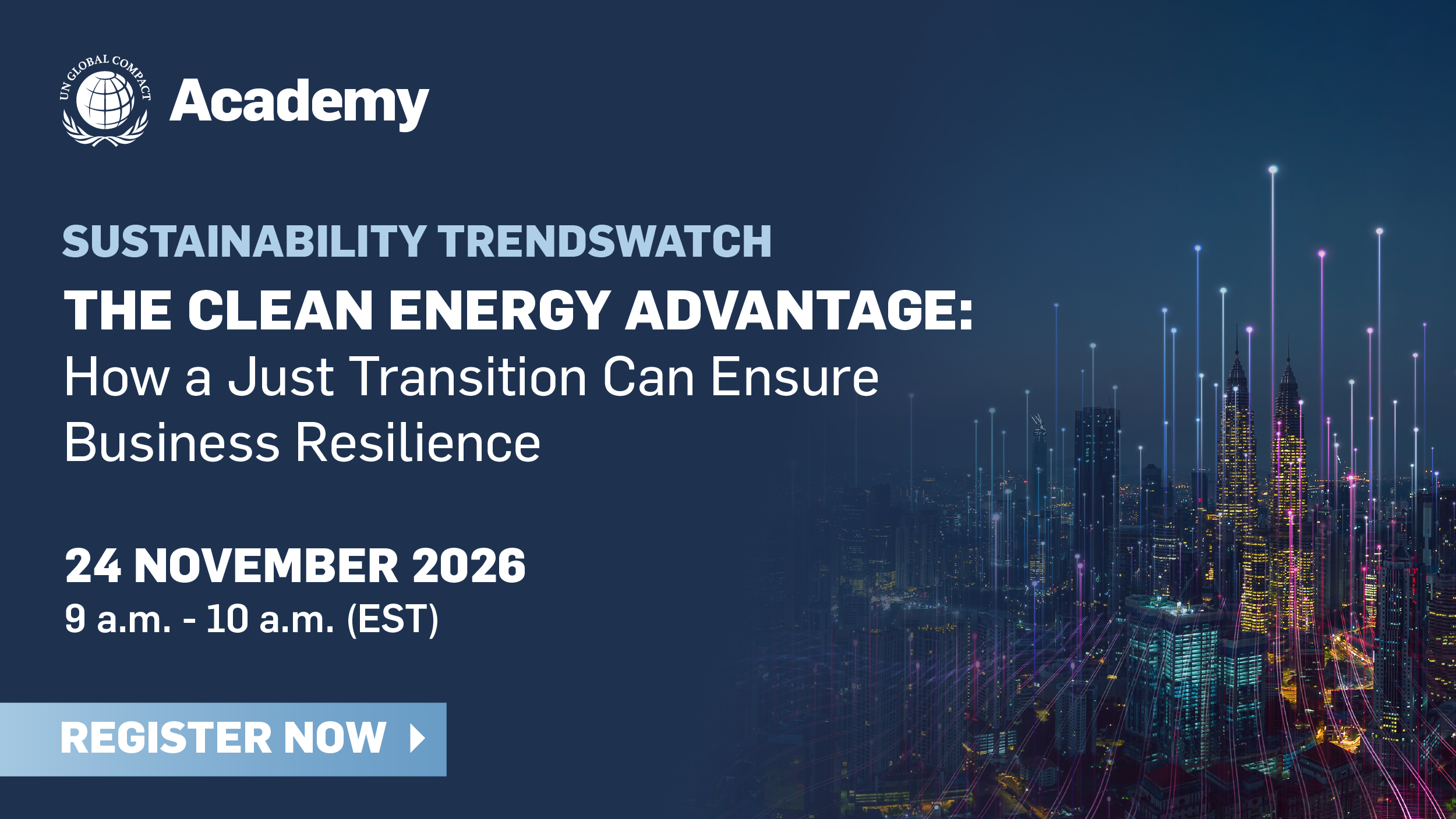
The global energy landscape is changing rapidly, creating new opportunities to accelerate a just transition.
Join us for the next session of the Sustainability TrendsWatch series, The Clean Energy Advantage: How a Just Transition Can Ensure Business Resilience, hosted by the UN Global Compact Academy.
As renewables, electrification and rising electricity demand reshape energy markets, businesses face both new challenges and significant opportunities. This session will explore the forces driving the energy transition, the barriers to scaling clean energy and how companies can leverage investment, purchasing power and collective action to expand renewable energy while creating long-term value for businesses and communities.
Discover how businesses can help advance an equitable energy transition that delivers for both people and the planet.
UN GCD Supply Chain Dialogue - Mining Sector in Southeast Asia
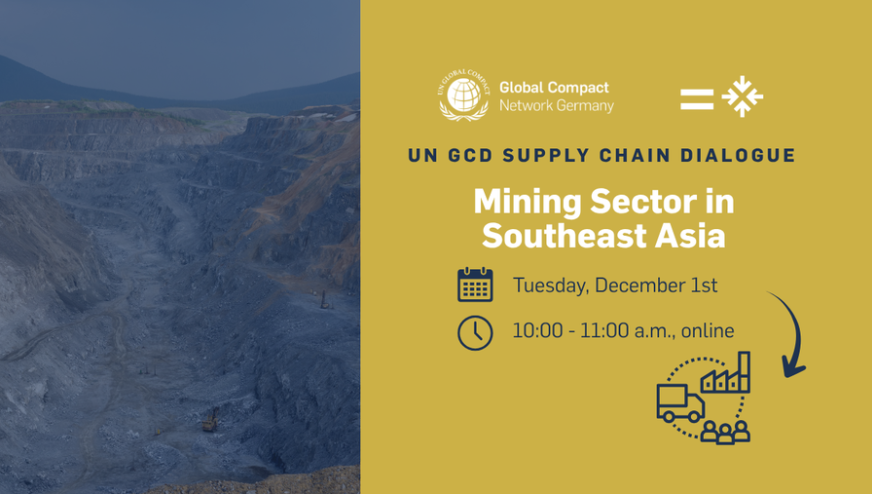
The UN GCD Supply Chain Dialogue 2026 brings together companies, suppliers, and rightsholder representatives to explore how human rights due diligence (HRDD) can become more effective, collaborative, and impactful.
The third session of the UN GCD Supply Chain Dialogue 2026 focuses on the mining and mineral sector in Asia, with a particular focus on Indonesia. It brings companies into dialogue with AEER – Aksi Ekologi & Emansipasi Rakyat, an Indonesian non-profit organisation working on environmental and energy issues in close connection with affected communities.
Drawing on its research-based advocacy and engagement with communities, financial institutions and policymakers, AEER will provide insights into the human rights and environmental impacts of mining and mineral supply chains. The discussion will explore how coal and nickel mining can affect local livelihoods, biodiversity, water resources, public health and the rights of affected communities – including in the context of the growing demand for critical minerals and low-carbon technologies.
Moving beyond a narrow focus on compliance, participants will examine how companies can identify and address impacts across complex mineral supply chains. The session will discuss meaningful engagement with rights-holders, responsible sourcing, corporate accountability and the role of human rights due diligence in supporting an ecologically just and socially fair transition.
Understanding Responsible Contracting - Session Three

The last webinar of the Responsible Procurement series centers around responsible contracting. It covers good practices for three main types of documents: general terms and conditions, codes of conduct, and purchasing contracts. At the core of the webinar will be the European Model Contracting Clauses. Overall, this webinar aims to enable companies to draft responsible policies and contracting clauses.
COP31 Debrief
Every year, the United Nations Framework Convention on Climate Change (UNFCCC) hosts its Conference of the Parties, or COP, to assess global progress on climate action and to unite stakeholders to work together on solutions.
With tens of thousands of participants and a multitude of sessions and agenda points, following and digesting the outcomes of COPs can be challenging.
On the heels of COP31 in Antalya, Türkiye, from 9 – 20 November 2026, the UN Global Compact Academy is proud to host the COP31 Debrief, a live webinar on 2 December 2026, providing expert context and nuance to the main headlines from COP31 and share priorities and opportunities for corporate action to drive progress in 2027.
Office Hours: Communication on Progress - Session three

Join the CoP team for a live Q&A office hours session, where they will walk through key requirements and share important updates for the 2026 Communication on Progress (CoP) reporting cycle.
The CoP is the primary reporting mechanism of the UN Global Compact and a mandatory annual requirement for all business participants. Participants are strongly encouraged to attend if they have questions about CoP requirements, reporting processes, or available support resources.
This session is also a great opportunity to learn more about the CoP Data Visualization Tools, available here.
NDE Session 6: Action Plan Presentation & Closing
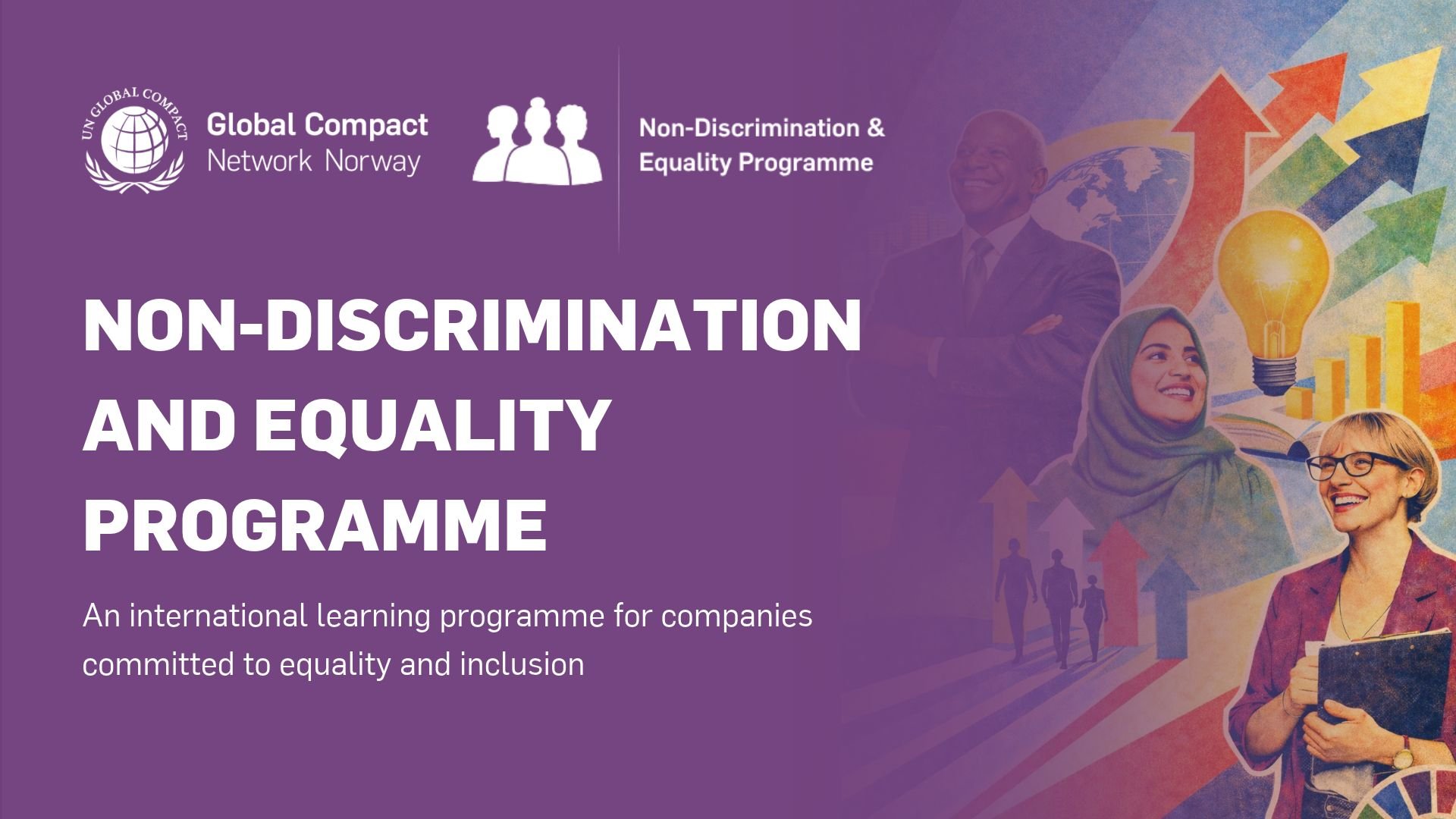
Ready to turn equality from a value into a daily business practice?
The programme on non-discrimination and equality is an online programme designed to support businesses in advancing equality and inclusion across their operations. If your company is ready to take meaningful steps to identify, assess, and address discrimination-related risks, this programme will guide you through the process with practical tools, expert insights and peer exchange.
Through six expert-led sessions, peer learning opportunities, and individual work, you will gain a solid understanding of how to assess impact, prioritize action, and embed non-discrimination across the workplace, supply chains, and communities.
The application deadline has passed. If you or anyone in your company would still like to participate, please contact us at medlem@globalcompact.no
Building the Business Case: Making Sustainability a C-Suite Investment Priority
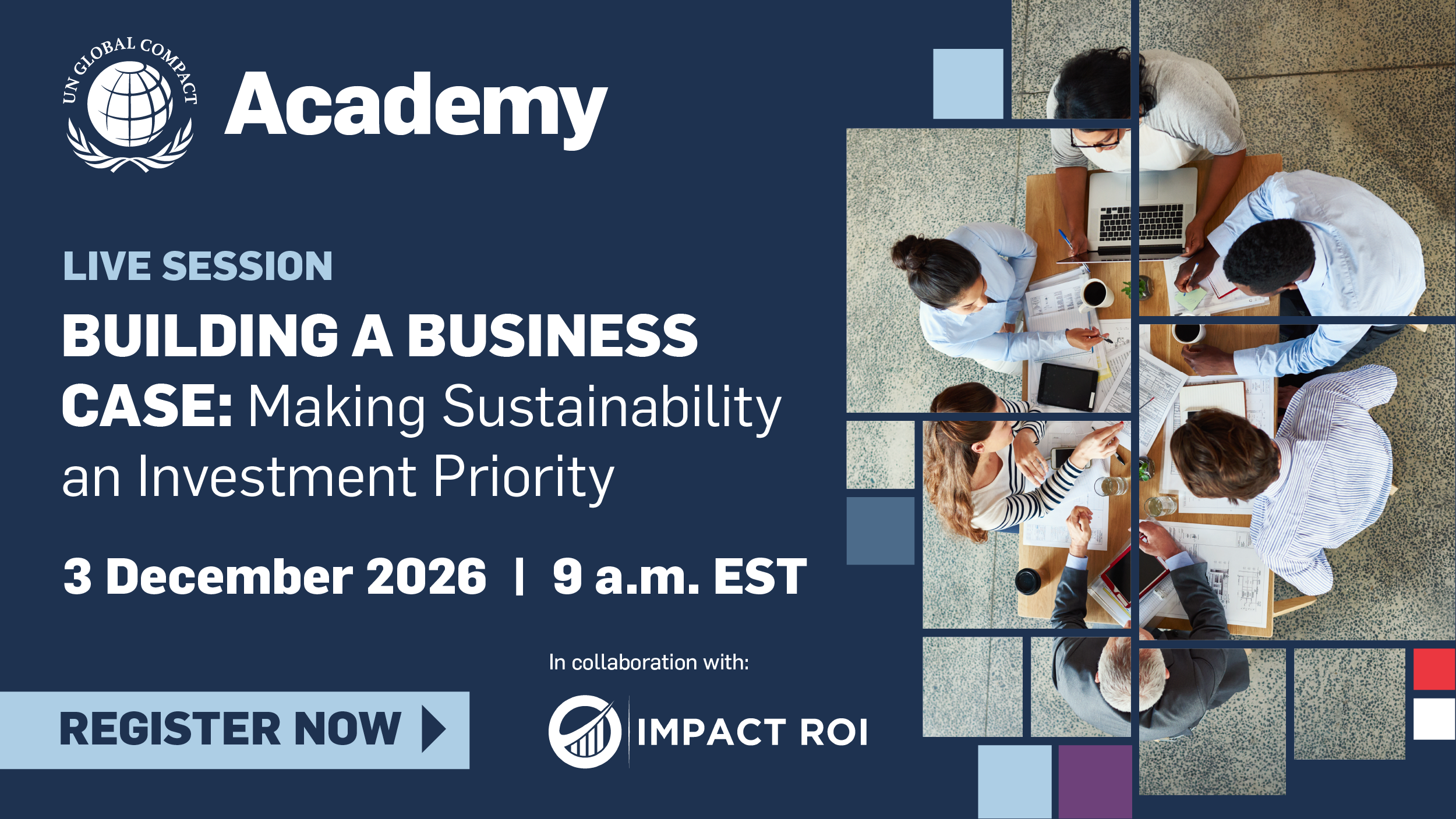
While many companies recognize the business case for sustainability, securing funding and leadership support remains a challenge. As companies plan for 2027, sustainability teams must demonstrate measurable business value, compete for limited budgets and make the case for investment in a way that resonates with finance and decision-makers.
To support you in making a stronger financial case for sustainability, the UN Global Compact Academy invites you to Building a Business Case: Making Sustainability an Investment Priority, taking place on 3 December 2026.
This 90-minute live session will bring together expert insights and real-world corporate perspectives to help you articulate the value of sustainability initiatives, understand what finance teams look for in investment proposals, and build a business case that secures buy-in.
ESG Regulatory Briefing

The regulatory frameworks governing corporate actions in the context of sustainability and corporate responsibility issues are evolving rapidly. After a long period mainly shaped by industry self-regulation, companies now face comprehensive expectations, detailed both in soft law standards and – increasingly – hard law.
The UN Global Compact Network Switzerland & Liechtenstein and other Global Compact Networks have mandated ECOFACT AG to support companies in responding to regulatory sustainability and corporate responsibility regulations. These quarterly briefings provide information related to actions that need to be taken today and in the near future to remain compliant and competitive.
Join us for the webinar during which you can expect to learn what the current regulatory trends and key EU and international regulatory developments are. The ESG Regulatory Briefings offer a concise, high-level overview of the fast-evolving regulatory landscape, flagging changes and supporting you in gaining an understanding of what needs to be prioritised.
Please note: while these briefings deliver a consistent, strategic view of the fast-evolving policy landscape, they are distinct from the UN Global Compact’s EU Sustainability Navigator sessions, which dive deeper into practical insights and policy context.
Language
This webinar will be conducted in English.
Measuring what matters: Driving integrity through monitoring, evaluation and continuous improvement

As expectations around business integrity continue to evolve, companies are increasingly required not only to implement anti-corruption ethics and compliance programmes, but also to demonstrate their effectiveness. Robust monitoring and evaluation can help organizations understand whether their programmes are achieving their intended objectives, identify areas for improvement, strengthen organizational culture, and support informed decision-making.
Drawing on the updated publication, An Anti-Corruption Ethics and Compliance Programme for Business: A Practical Guide (2026), this session will examine practical approaches to monitoring and evaluation, including the use of indicators, audits, surveys, and other tools to assess programme performance and company culture. The session will also explore how companies can apply structured evaluation frameworks to identify gaps and embed continuous improvement into their compliance systems.
Living Wages in Practice - Part 1
Living wages are quickly becoming a central topic in responsible business conduct, human rights due diligence and sustainability reporting. But what exactly is a living wage, and what does it mean for companies in practice?
This introductory webinar of our four-part series "Living Wages in Practice: Turning ambitions into actions" explores what a living wage means in practice and how businesses can advance living wages and contribute to meaningful progress.
What we will cover
The basics: what a living wage is and why it matters for your business
Methodologies and benchmarks: the key approaches used to assess living wages
Regulation and global initiatives: how they are driving corporate action
Company insights: companies already working on living wages share their approaches, experiences and lessons learned
What you will take away
A better understanding of how your company can advance living wages, and where to start.
Language
This webinar will be conducted in English.
Living Wages in Practice - Part 2
Many companies start their living wage journey within their own operations, but identifying wage gaps and ensuring fair pay across different categories of workers can be more complex than expected.
This second webinar of our four-part series "Living Wages in Practice: Turning ambitions into actions" explores how companies can assess wages and ensure fair pay across their own operations.
What we will cover
Assessing wages: how to assess wages for direct employees, subcontracted workers and contracted service workers
Internal decisions: how purchasing practices and service contracting can influence wage outcomes
Disclosure and reporting: how companies are beginning to disclose progress and meet reporting expectations under frameworks such as the Corporate Sustainability Reporting Directive (CSRD)
What you will take away
A clearer picture of how to identify wage gaps across all categories of workers in your own operations, and how to report on your progress.
Language
This webinar will be conducted in English.
Living Wages in Practice - Part 3
For most companies, the largest living wage gaps exist deep within their supply chains. So where should companies begin?
This third webinar of our four-part series "Living Wages in Practice: Turning ambitions into actions" focuses on practical strategies for engaging suppliers and prioritizing action in complex global supply chains.
What we will cover
Engaging suppliers: practical strategies for engaging suppliers and integrating living wage expectations into procurement practices
Risk-based approach: why it makes sense to identify the most relevant suppliers, tiers and geographies
Pilot initiatives: how focused pilots can help companies make progress step by step
Measuring progress: approaches to measuring progress, setting realistic milestones and building a foundation for continuous improvemen
What you will take away
A clear idea of where to begin in your supply chain, how to prioritize action and how to measure progress over time.
Language
This webinar will be conducted in English.
Living Wages in Practice - Part 4
Once companies have identified their living wage gaps, the next question is how to close them.
This final webinar of our four-part series "Living Wages in Practice: Turning ambitions into actions" explores how companies can interpret living wage data, identify the most effective mechanisms for closing wage gaps and engage the right stakeholders across their supply chains.
What we will cover
Interpreting data: how to make sense of living wage data
Closing wage gaps: how to identify the most effective mechanisms
Engaging stakeholders: approaches such as worker engagement, supplier collaboration and collective bargaining
Communicating progress: how to communicate progress credibly to internal and external audiences
What you will take away
A better understanding of which mechanisms can close wage gaps, who to involve and how to communicate your progress credibly.
Language
This webinar will be conducted in English.
Start with Nature: An Introduction for Businesses
Businesses rely on healthy ecosystems for raw materials, clean water and resilient supply chains. Understanding how an organization both depends on and impacts the natural world has become a prerequisite for its long-term performance.
Organized in collaboration with the Taskforce on Nature-related Financial Disclosures (TNFD), this webinar explains why nature needs a place on the corporate agenda and how to make a start in practice.
Participants will:
Gain an overview of the tools and guidance available, including an input from TNFD
Learn about the first steps businesses take when starting to engage on nature
Hear examples and good practices
The session concludes with a Q&A, giving participants the opportunity to ask their own questions.
ESRS Updates & Voluntary Sustainability Reporting Standards
Are you struggling to keep up with the rapid evolution of EU sustainability regulations?
Join us on 12 November 2026 for the final session of the 2026 EU Sustainability Navigator series, hosted by the UN Global Compact Academy.
In this session, sustainability experts will unpack the latest ESRS updates and simplifications, exploring what they mean for CSRD-aligned reporting and how companies can strengthen disclosures through voluntary standards and practical approaches to materiality.
Can’t attend live? Register to receive access to the on-demand recording.
Understanding Responsible Purchasing Practices - Session Two

The second webinar of the Responsible Procurement series focuses on purchasing practices, their impacts and examples for both good and bad practices. It aims to provide companies with the ability to review their own purchasing practices as well as a set of concrete responsible practices to potentially implement.
NDE Session 5: Communication & Reporting
Ready to turn equality from a value into a daily business practice?
The programme on non-discrimination and equality is an online programme designed to support businesses in advancing equality and inclusion across their operations. If your company is ready to take meaningful steps to identify, assess, and address discrimination-related risks, this programme will guide you through the process with practical tools, expert insights and peer exchange.
Through six expert-led sessions, peer learning opportunities, and individual work, you will gain a solid understanding of how to assess impact, prioritize action, and embed non-discrimination across the workplace, supply chains, and communities.
The application deadline has passed. If you or anyone in your company would still like to participate, please contact us at medlem@globalcompact.no
Office Hours: Communication on Progress - Session two

Join the CoP team for a live Q&A office hours session, where they will walk through key requirements and share important updates for the 2026 Communication on Progress (CoP) reporting cycle.
The CoP is the primary reporting mechanism of the UN Global Compact and a mandatory annual requirement for all business participants. Participants are strongly encouraged to attend if they have questions about CoP requirements, reporting processes, or available support resources.
This session is also a great opportunity to learn more about the CoP Data Visualization Tools, available here.
UN GCD Supply Chain Dialogue - Working Conditions in India
The UN GCD Supply Chain Dialogue 2026 brings together companies, suppliers, and rightsholder representatives to explore how human rights due diligence (HRDD) can become more effective, collaborative, and impactful.
The first session of the UN GCD Supply Chain Dialogue 2026 focuses on labour conditions in India and brings companies into direct dialogue with ASK India, an organisation with extensive experience working with workers, suppliers and companies across global supply chains.
Drawing on its practical work in the manufacturing and service sectors, ASK India will provide insights into the realities and root causes behind labour rights risks in supply chains. The discussion will address issues such as recruitment practices, wages and statutory benefits, working hours, forced labour, harassment and abuse, gender discrimination, grievance mechanisms and worker representation.
Moving beyond compliance-driven approaches such as social audits and self-assessment questionnaires, the webinar will explore how companies can better understand working conditions on the ground and engage meaningfully with workers and their representatives. Participants will gain practical perspectives on how worker engagement, contextual knowledge, trust and constructive collaboration with suppliers can strengthen human rights due diligence and contribute to more effective action.
Understanding Responsible Procurement and Shared Responsibility - Session One

This first webinar of the Responsible Procurement series offers an introduction to responsible procurement, outlines the relevant EU legal requirements as well as international standards, and closes by defining the shared responsibilities of buyers and suppliers in advancing HREDD. It will equip attendees with a basic understanding of responsible procurement and its relevance to their work.
AI and Human Rights: Powering the Future Through a Just Energy Transition

Ensuring AI infrastructure respects human rights is essential.
Join us for our next AI and Human Rights session on 8 October at 3 p.m. as we explore how businesses and investors can finance and deploy AI energy infrastructure in line with the UN Guiding Principles on Business and Human Rights (UNGPs). The session will examine how companies can identify and address human rights risks, engage meaningfully with affected stakeholders, protect community land and resource rights and help ensure the benefits of the AI and clean energy transitions are shared equitably.
Live translation will be available in French, Spanish and Portuguese.
Can't attend live? Register to receive an on-demand recording after the webinar concludes.
Office Hours: Communication on Progress - Session one

Join the CoP team for a live Q&A office hours session, where they will walk through key requirements and share important updates for the 2026 Communication on Progress (CoP) reporting cycle.
The CoP is the primary reporting mechanism of the UN Global Compact and a mandatory annual requirement for all business participants. Participants are strongly encouraged to attend if they have questions about CoP requirements, reporting processes, or available support resources.
This session is also a great opportunity to learn more about the CoP Data Visualization Tools, available here.
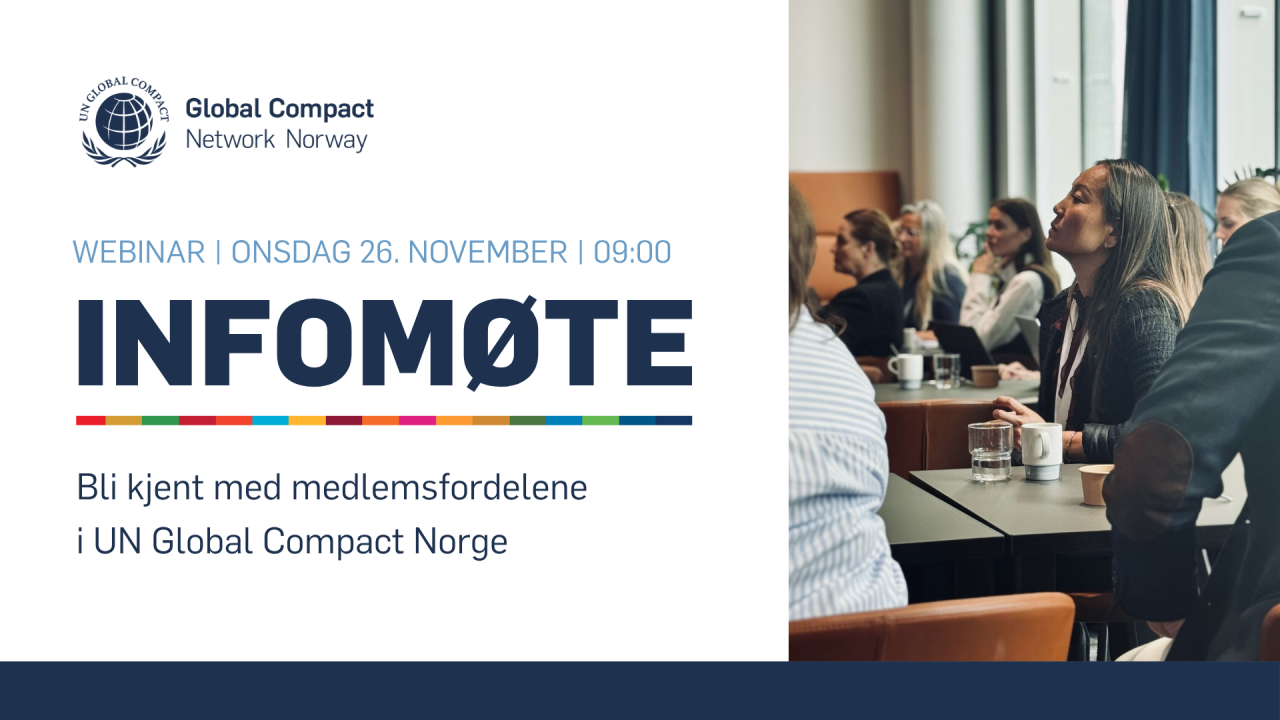
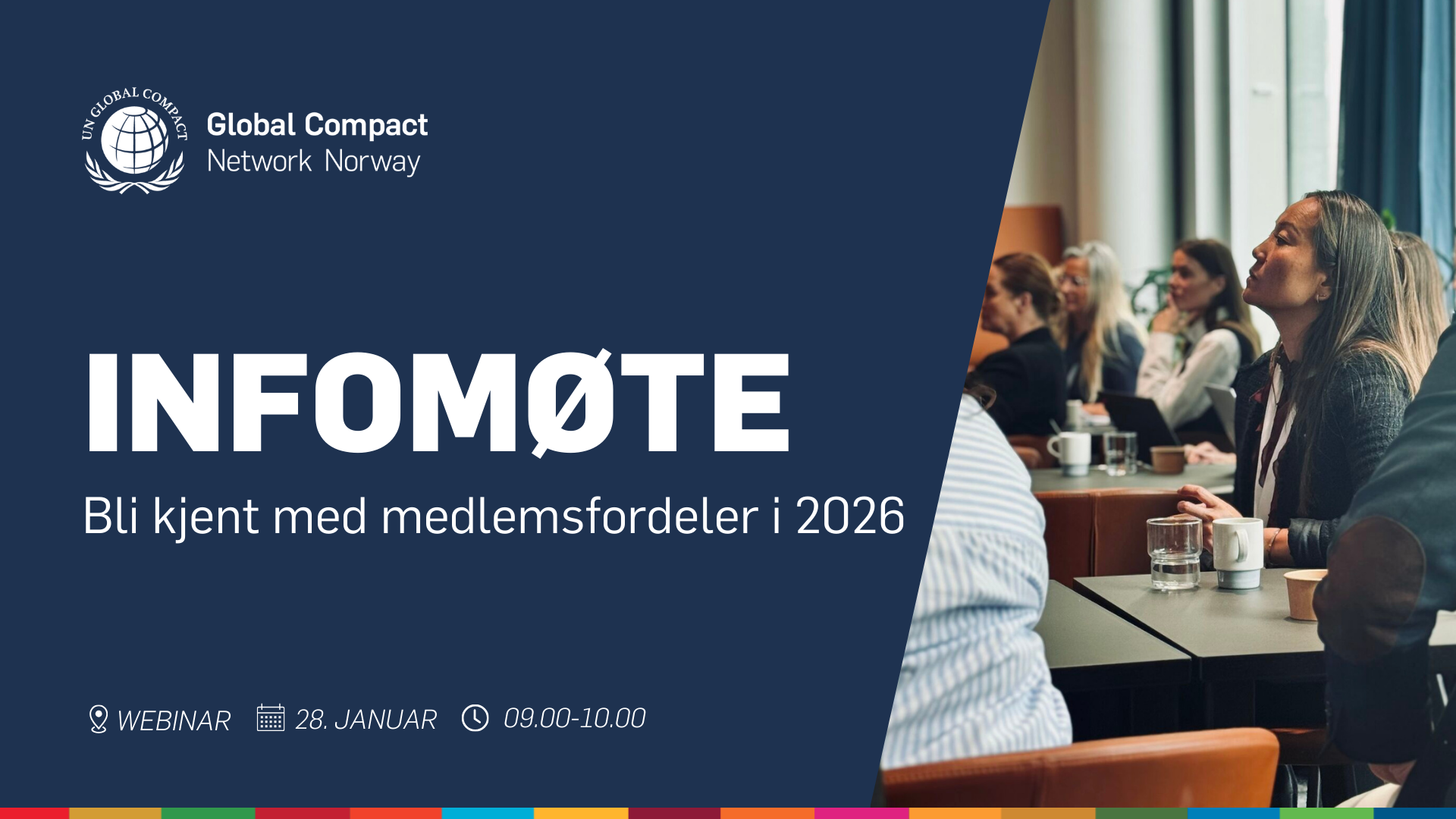
Infomøte om medlemsfordeler i UN Global Compact Norge
Her får du oversikt over medlemsfordeler og hvilke tilbud din bedrift kan benytte og delta på ut 2026, samt kommende muligheter i 2027.
Som medlem i UN Global Compact Norge har du og alle dine kollegaer tilgang til en rekke tilbud, både gjennom organisasjonens internasjonale nettverk og det norske nettverket.
På infomøtet, vil du få informasjon om:
Aktuelle arrangementer lokalt, nasjonalt og internasjonalt
Nettverksmuligheter og arenaer for erfaringsdeling som Nettverk for bærekraftsledere og Sustainability Enablers Forum
Muligheter for kompetanseheving og verktøy for innen vitenskapbaserte klimamål, sirkulærøkonomi, ikke-diskriminering og likestilling, og på den digitale læringsplattformen Academy med over 100 e-læringer og webinarer
Innlevering av Fremgangsmeldingen (CoP) i 2026
Q&A – mulighet til å stille spørsmål om det du lurer på
Finn informasjon om aktuelle medlemsfordeler og kommende arrangementer på nettsiden.
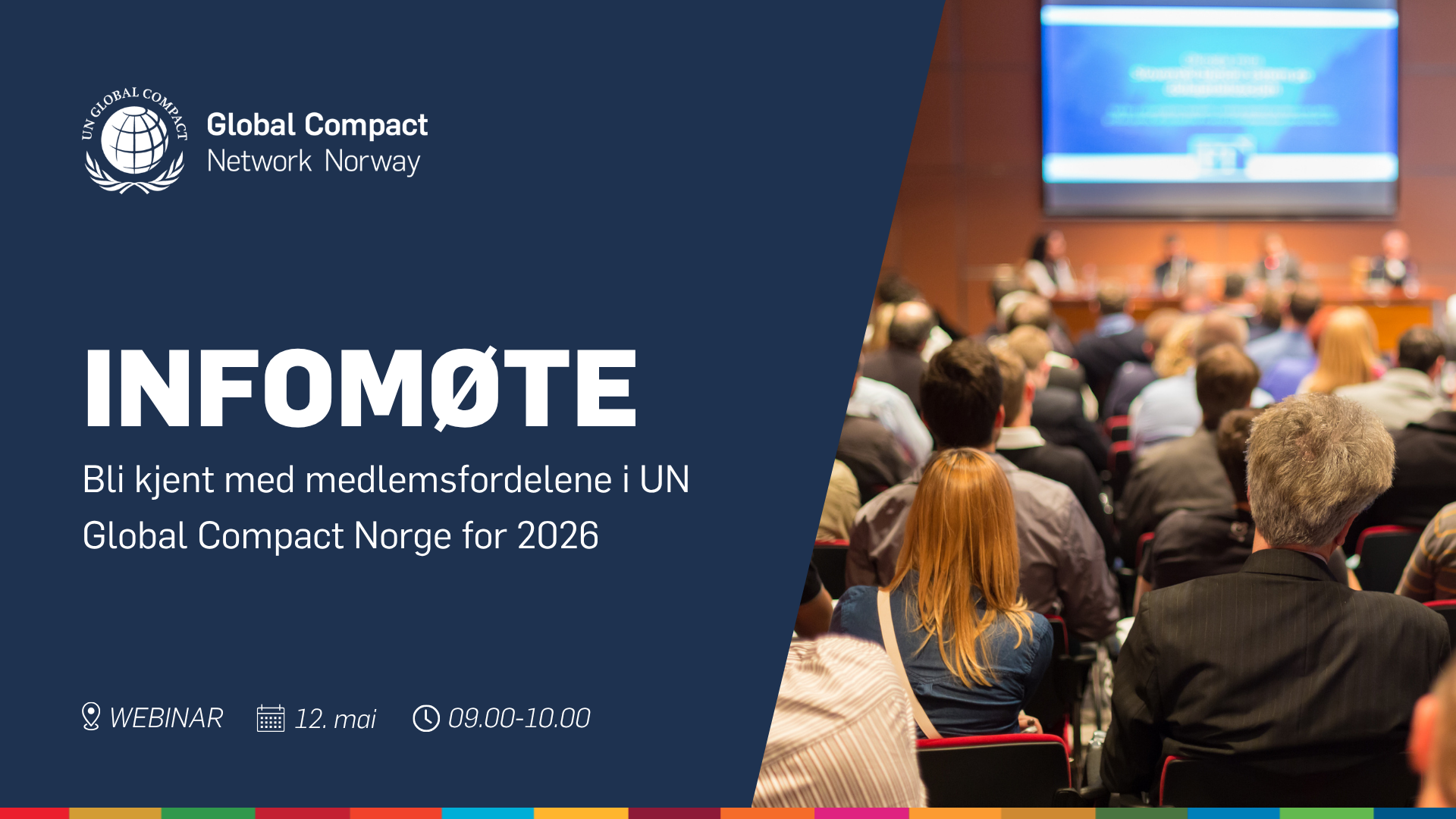
Infomøte om medlemsfordeler i UN Global Compact Norge
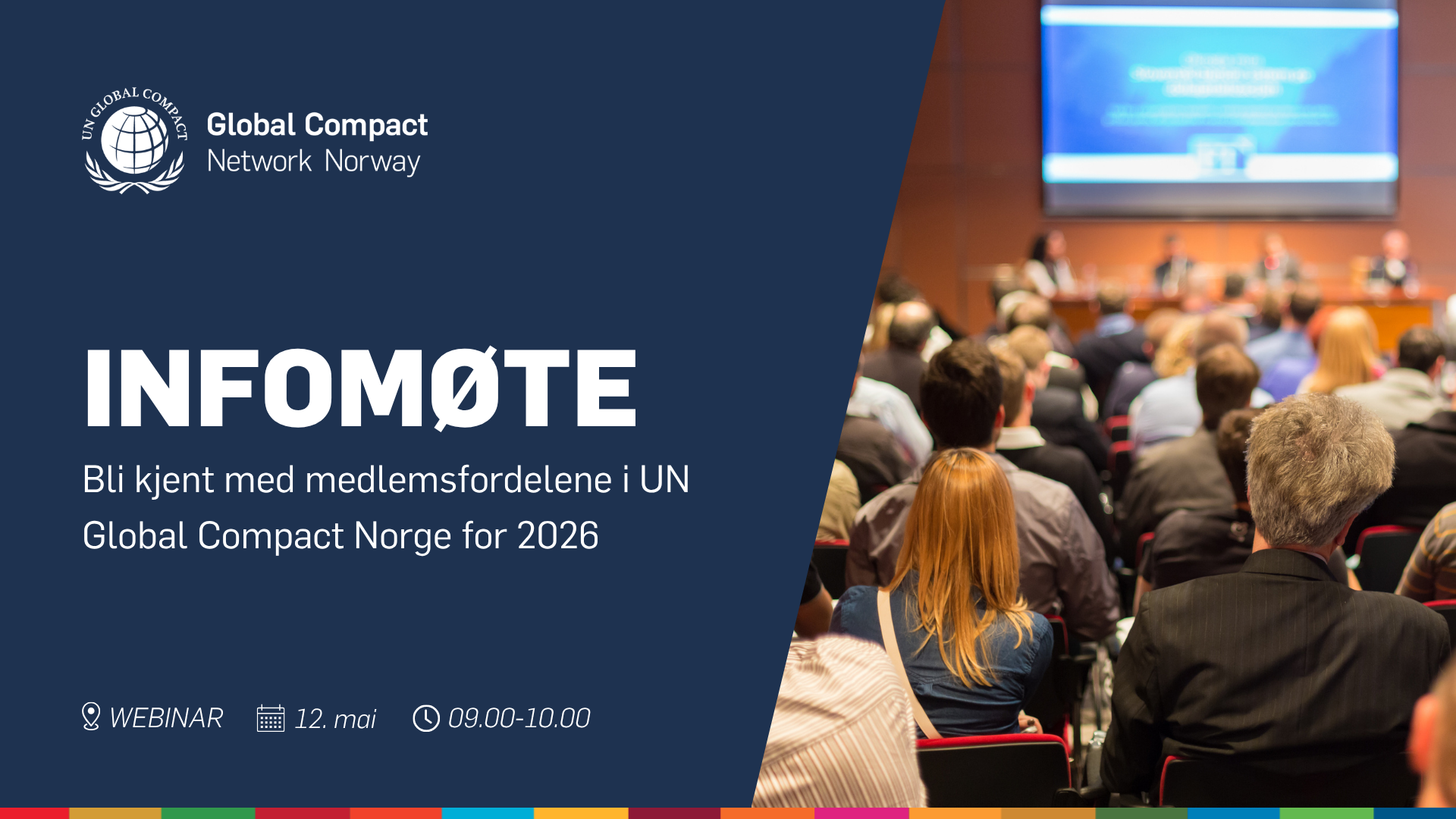
Ønsker du å få oversikt over medlemsfordeler og hvilke tilbud din bedrift kan benytte og delta på i 2026?
Som medlem i UN Global Compact Norge har du og alle dine kollegaer tilgang til en rekke tilbud, både gjennom organisasjonens internasjonale nettverk og det norske nettverket.
På infomøtet, vil du få informasjon om:
Aktuelle arrangementer lokalt, nasjonalt og internasjonalt tilknyttet Arendalsuka, Nordic Meeting, klimatoppmøtet COP og UN General Assembly
Nettverksmuligheter og arenaer for erfaringsdeling som Nettverk for bærekraftsledere og Forum for bærekraftens drivere
Muligheter for kompetanseheving og verktøy for innen sirkulærøkonomi, ikke-diskriminering og likestilling, og på den digitale læringsplattformen Academy med over 100 e-læringer og webinarer
Innleveringsperioden for Fremgangsmeldingen (CoP) i 2026 og årets oppdateringer
Q&A – mulighet til å stille spørsmål om det du lurer på
Finn informasjon om aktuelle medlemsfordeler og kommende arrangementer på nettsiden.
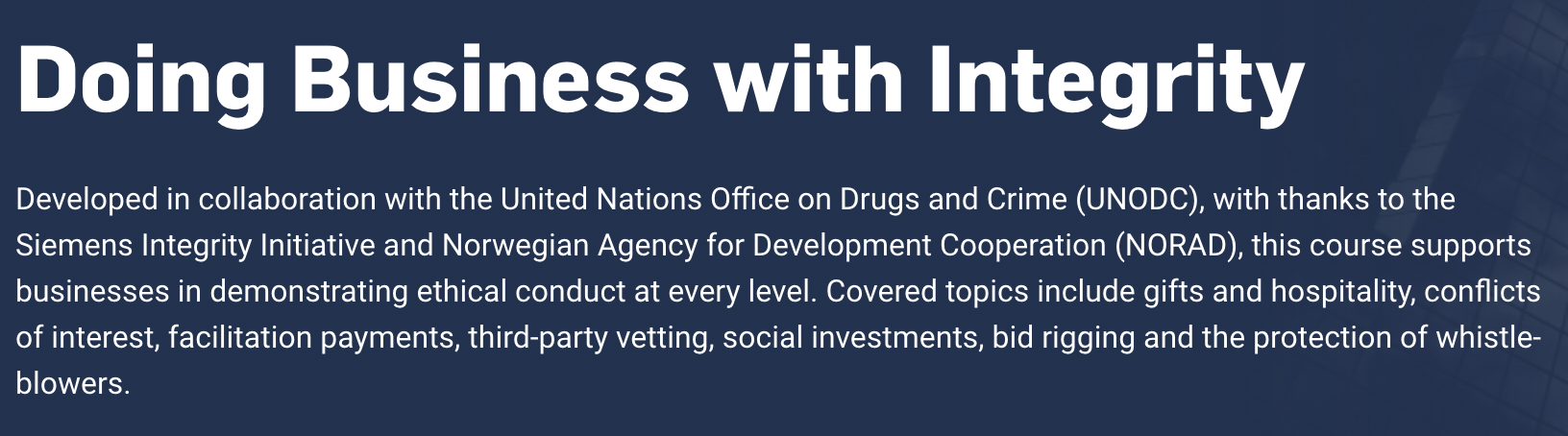
Doing Business with Integrity
Kravene til etisk forretningspraksis øker, og virksomheter forventes å kunne dokumentere
høy integritet i alt de gjør. Det nye e-læringskurset Doing Business with Integrity, utviklet av
UN Global Compact og UNODC med støtte fra Siemens Integrity Initiative og NORAD, gir
en praktisk innføring i hvordan korrupsjonsrisiko kan forebygges og håndteres i daglige
arbeidssituasjoner.
Kurset tar for seg realistiske dilemmaer knyttet til gaver og representasjon,
interessekonflikter, tilretteleggingsbetalinger, tredjepartsaktører, anbudsprosesser og varsling.
Målet er å styrke virksomheters evne til å ta gode etiske beslutninger og bygge en kultur
preget av åpenhet og ansvarlighet. Deltakerne mottar sertifikat ved fullføring.
Digitalt
Climate Action Platform – en læringsplattform for strategisk klimaarbeid
Climate Action Platform er en faglig læringsplattform for virksomheter som jobber strategisk og systematisk med klima. Plattformen gir deltakerne tilgang til et profesjonelt nettverk av klima- og bærekraftsansvarlige, og et nøytralt rom for å diskutere konkrete klimautfordringer, nye prioriteringer og praktiske løsninger.
Gjennom plattformen kan virksomheter dele erfaringer, beste praksis og innovative tilnærminger til klimaarbeid, styrke egne strategier og lære av andre selskaper på tvers av sektorer og geografi. Diskusjonene er praksisnære og rettet mot faktiske utfordringer virksomheter står i, både strategisk og operativt.
Climate Action Platform er lagt opp med fleksibel deltakelse. Virksomheten velger selv hvilke interne eksperter som deltar i de ulike sesjonene, avhengig av tema og behov. Dette gjør det mulig å koble riktig kompetanse til riktig diskusjon, og sikre høy relevans for egen organisasjon.
Praktisk oppsett og deltakelse
Plattformen består av digitale, interaktive faglige sesjoner gjennom året. Samlingene gjennomføres på engelsk og er organisert som workshops med faglige innledninger, erfaringsdeling og diskusjoner i mindre grupper. Deltakelsen er ment å være aktiv og dialogbasert, med vekt på læring og erfaringsutveksling mellom deltakerne.
Digitale plasser er tilgjengelige og deltakelse er gratis for medlemmer av UN Global Compact.
For mer informasjon om målgruppe, tematikk, struktur og forventninger til deltakelse, se FAQ her.
Frist for påmelding: 27. februar.
Innspillsmøte: næringslivets perspektiver til Norges FN-rapportering på bærekraftsmålene
I 2026 leverer Norge sin tredje frivillige nasjonale rapport (VNR) til FN om fremdriften på bærekraftsmålene. Forrige rapport ble levert i 2021, og regjeringen har i 2025 lagt frem en oppdatert status for arbeidet med bærekraftsmålene gjennom bærekraftsmeldingen.
UN Global Compact Norge er bedt om å koordinere et eget innspill fra privat næringsliv, og inviterer medlemsbedrifter til et åpent, digitalt innspillsmøte torsdag 12. februar kl. 14–15.
Møtet tar utgangspunkt i eksisterende statusbeskrivelser, og er ment å supplere dette med næringslivets perspektiver på:
hvor Norge faktisk står i arbeidet med bærekraftsmålene
sentrale barrierer for gjennomføring
områder der næringslivet har særlig stor påvirkning – positiv og negativ
Innspillsmøtet er et lavterskelrom for refleksjon og deling. Det er ingen krav til forberedelser, og det er fullt mulig å delta uten å ta ordet. Innspillene vil inngå som grunnlag for UNGC Norges samlede næringslivsinnspill til myndighetene.
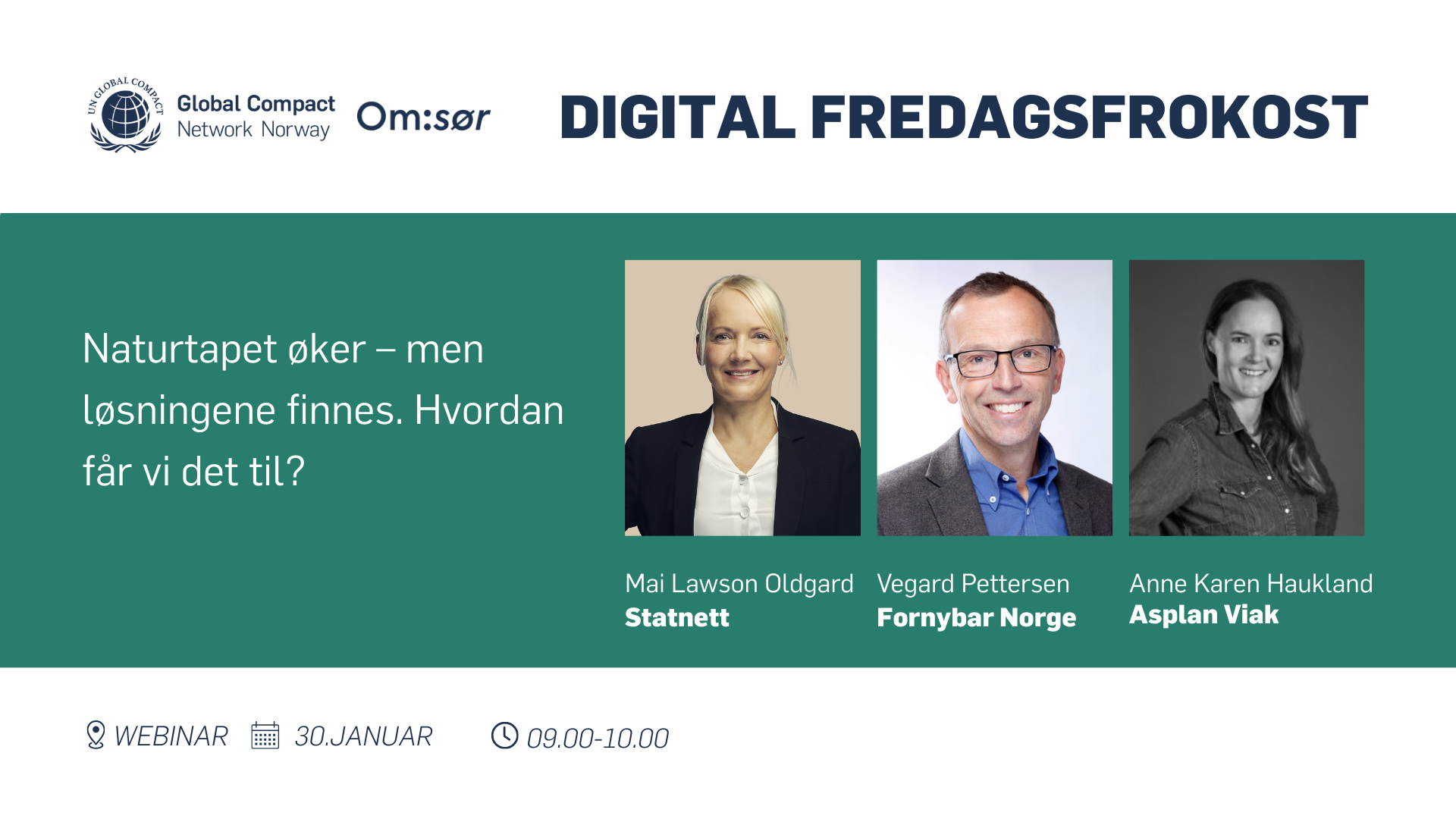
Naturtapet øker – men løsningene finnes. Hvordan får vi det til?
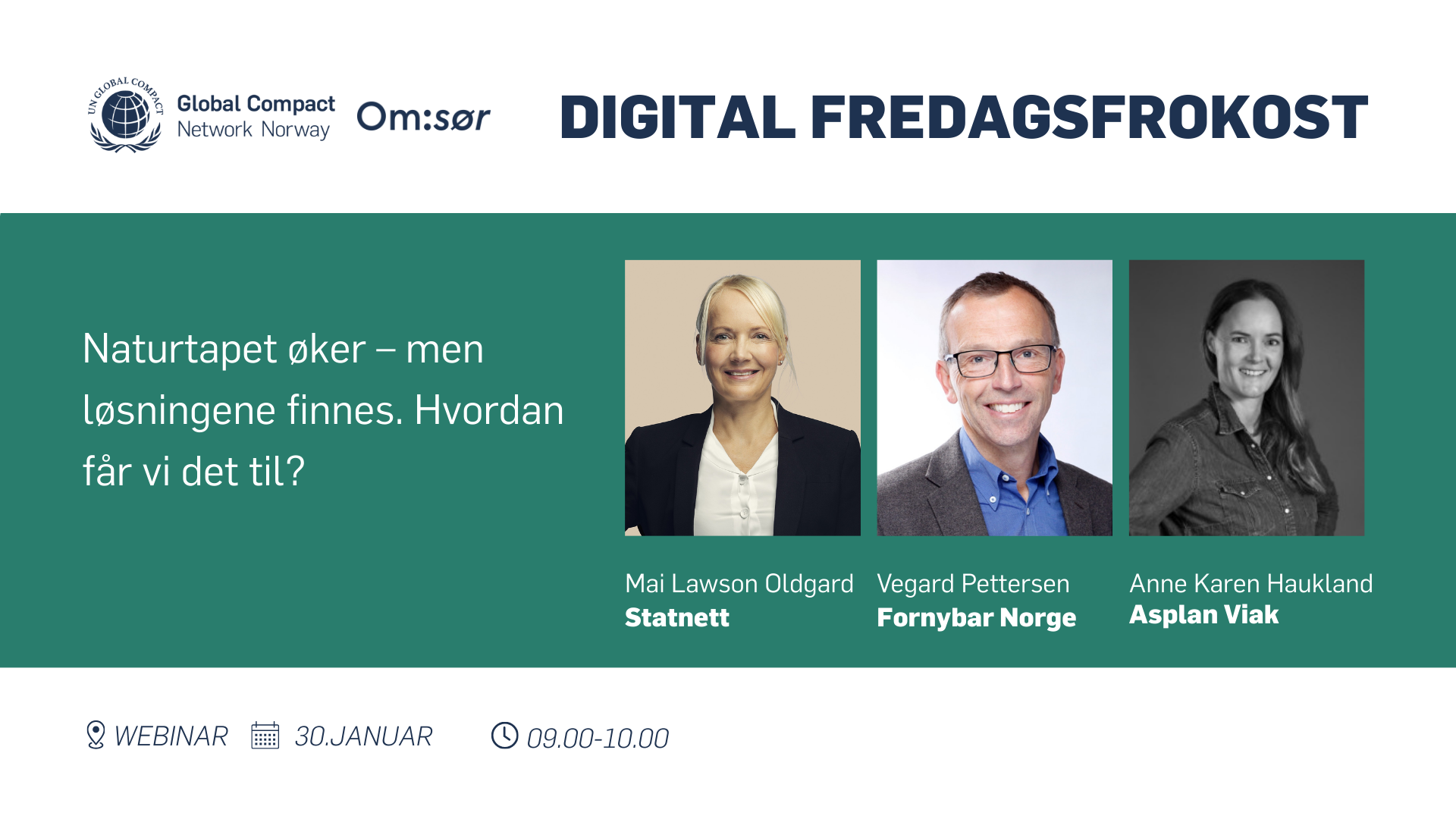
I del 2 av webinarene i Digital Fredagsfrokost om naturtap går vi fra hvorfor handling uteblir til hva som faktisk fungerer. Hvordan kan virksomheter redusere sin påvirkning på natur i praksis, og hvilke verktøy og metoder gir bedre beslutningsgrunnlag i møte med økende krav fra EU, markedet og samfunnet?
📅 Fredag 30. januar
⏰ 09.00–10.00
💻 Webinar
Du møter:
• Mai Lawson Oldgard, Direktør bærekraft, Statnett
• Vegard Pettersen, Bransjedirektør bærekraft, Fornybar Norge
• Anne Karen Haukland, Fagsjef konsekvensutredninger, Asplan Viak
Innlederne deler konkrete eksempler på tilnærminger, utfordringer og løsninger som kan bidra til å redusere naturtap.
Infomøte om medlemstilbud i 2026
UN Global Compact er en global organisasjon med mange medlemsfordeler for deltakende bedrifter. I tillegg til muligheter i det internasjonale nettverket, har bedrifter i det norske nettverket også tilgang på arenaer i Norge for erfaringsutveksling og kompetanseutvikling innen temaer knyttet til De ti prinsippene for ansvarlig næringsliv.
Er du nysgjerrig på medlemsfordelene i UN Global Compact og hvilke medlemstilbud du kan delta på og benytte i 2026? Meld deg på infomøtet for å få oversikt.
På infomøtet vil du få informasjon om:
· Aktuelle arrangementer lokalt, nasjonalt og internasjonalt
· Nettverksmuligheter og arenaer for erfaringsdeling
· Muligheter for kompetanseheving for alle ansatte
· Internasjonale muligheter og arenaer
· Ressurser og verktøy dere har tilgang på gjennom medlemskapet
· Innlevering av Fremgangsmeldingen (CoP) i 2026
· Q&A – mulighet til å stille spørsmål om det du lurer på
Gikk du glipp av forrige infomøte? Se opptak her på den splitter nye nettsiden vår.

Business & Human Rights Accelerator
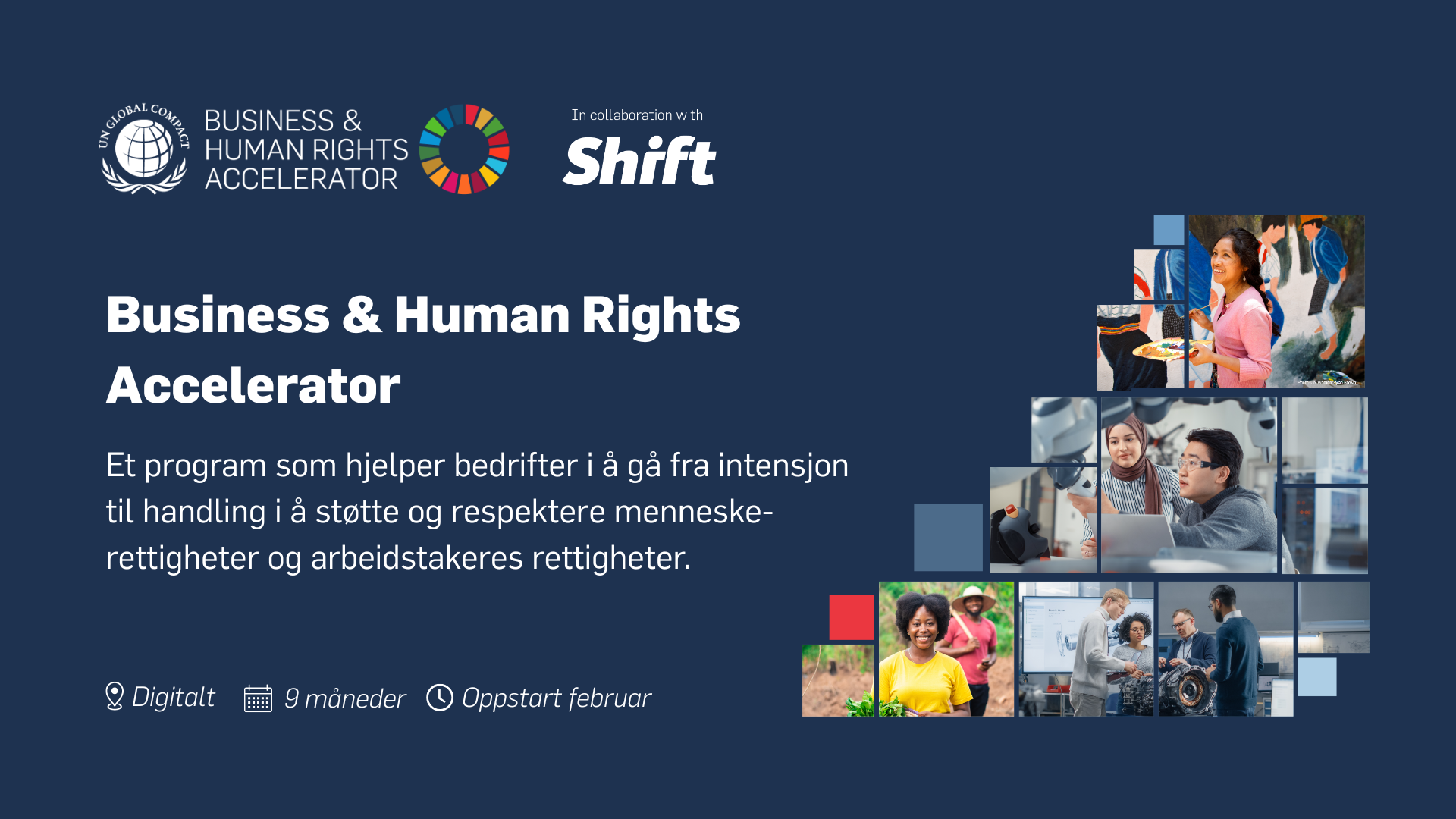
Business & Human Rights Accelerator er et program fra UN Global Compact og Shift, som hjelper bedrifter i å gå fra intensjon til handling i å støtte og respektere menneskerettigheter og arbeidstakeres rettigheter. Deltakerne får støtte til å identifisere vesentlige påvirkninger, etablere aktsomhetsprosesser og utvikle en konkret handlingsplan for sin virksomhet. Programmet gir praktisk veiledning i å prioritere risiko, redusere negative påvirkninger, følge opp effekten av tiltak og kommunisere innsatsen på en troverdig måte.
Les mer om programmet og søk plass her.
Webinar: Measuring and Reporting Progress on Equal Pay for Work of Equal Value

Arrangert av FNs Global Compact i samarbeid med ILO vil dette webinaret utforske hvordan lik lønn for arbeid av lik verdi fremmer likestilling, beskytter menneskerettigheter og styrker virksomheters resultater i drift og leverandørkjeder. Du får lære hvordan Forward Faster-initiativet støtter bedrifter i å forplikte seg til, følge opp og rapportere om lønnslikestilling, med praktiske verktøy, konkrete strategier og innsikt fra organisasjoner som leder an.
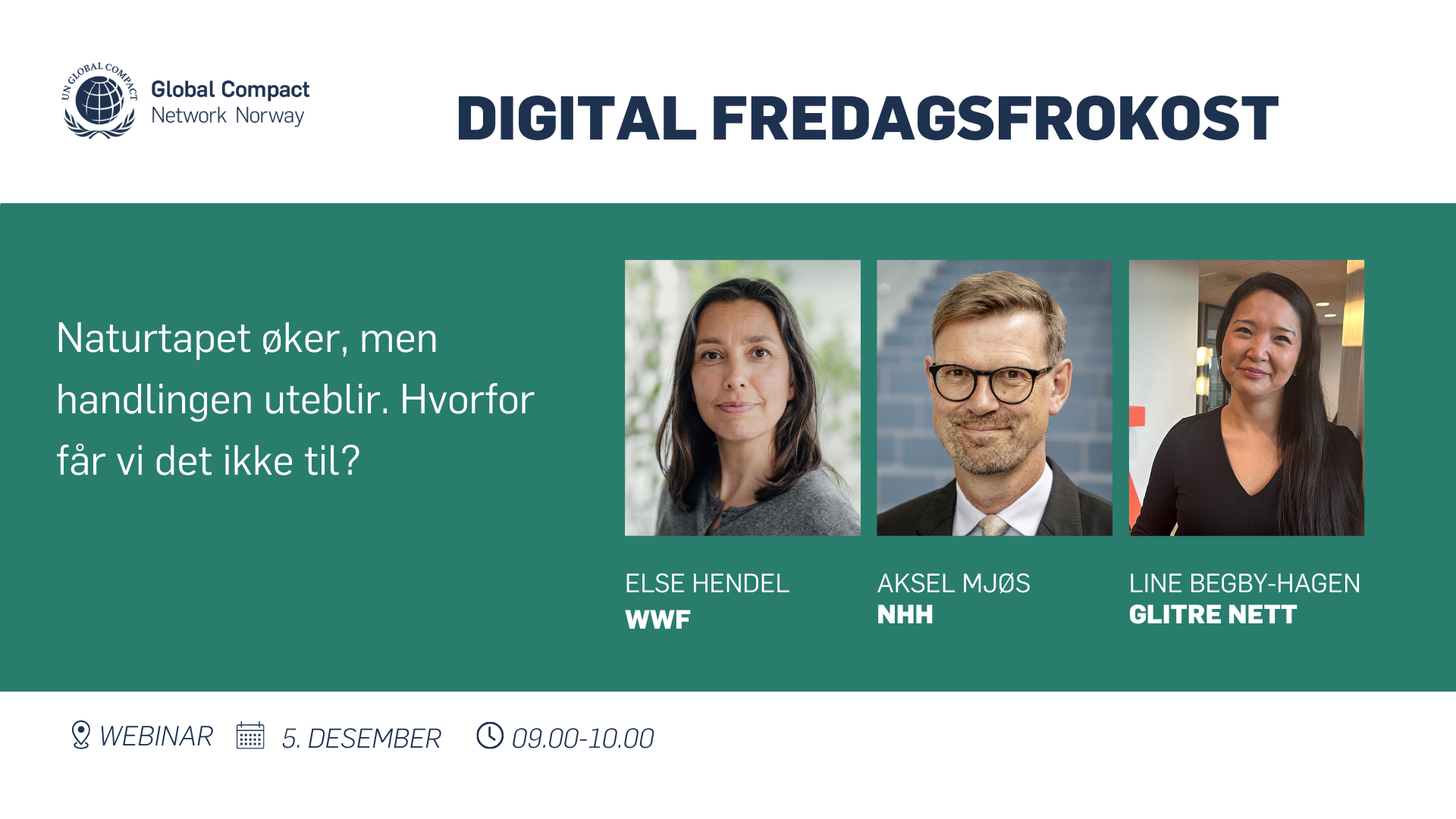
Digital fredagsfrokost: Naturtapet øker – men handlingen uteblir. Hvorfor får vi det ikke til?
Til sammen bygger Europa ned nesten 50 kvadratmeter natur og matjord i sekundet, viser nye publiseringer fra NRK og Norsk Institutt for Naturforskning (NINA). Og det er vi nordmenn som bygger ned mest natur per innbygger. For næringslivet betyr naturtapet både operasjonell, finansiell og regulatorisk risiko. Tilgang til naturressurser, sårbarhet i verdikjeder, strengere rapporteringskrav og økende forventninger fra kunder og investorer gjør natur til et strategisk spørsmål.
I dette webinaret tar vi en ærlig samtale om hvorfor natur fortsatt nedprioriteres. Du får høre fra Else Wendel (WWF), Aksel Mjøs (NHH) og Line Begby-Hagen (Glitre Nett)
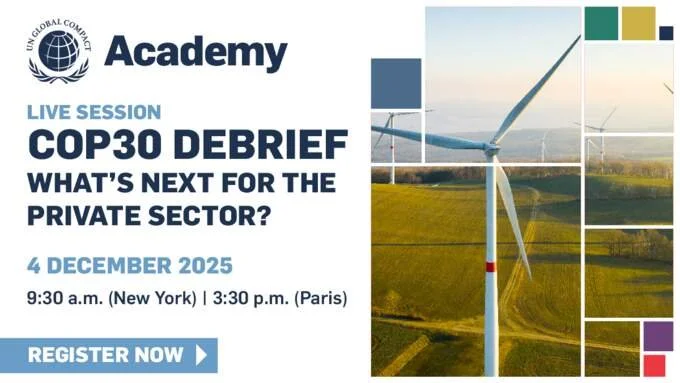
Klimatoppmøtet COP30 – Hva betyr resultatene for næringslivet?
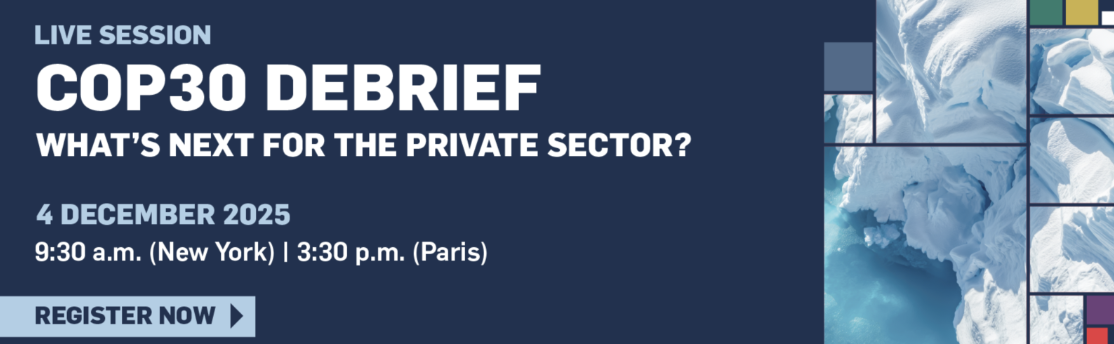
Få med deg de viktigste innsiktene fra klimatoppmøtet i Belém, Brasil.
Eksperter fra FNs klimasekretariat og Generalsekretærens klimahandlingsteam deler hovedfunnene fra COP30 – inkludert den nye femårsplanen for global klimahandling og hvordan næringslivet kan bidra til å levere på Parisavtalen.
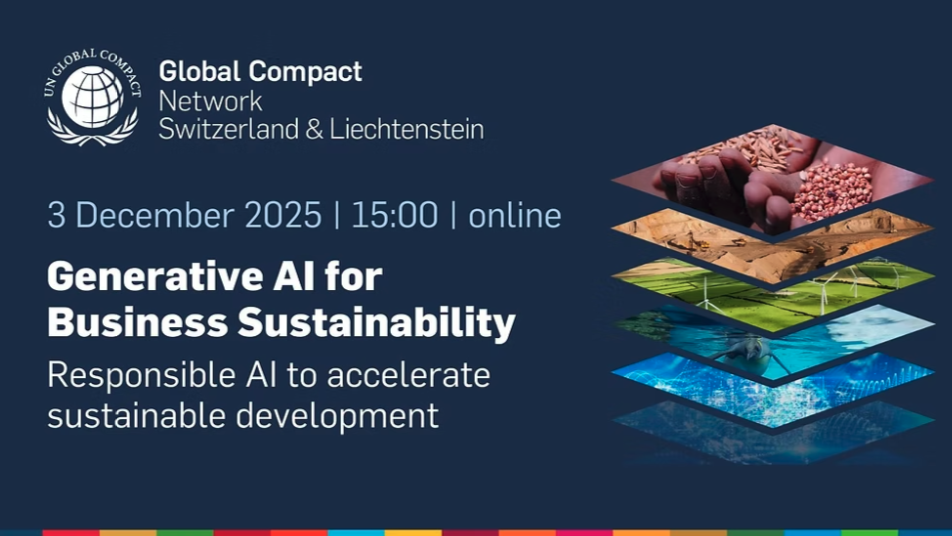
Generativ AI for bærekraftig næringsliv – ansvarlig bruk for å akselerere bærekraftig utvikling
Hvordan kan generativ kunstig intelligens bidra til bærekraftig utvikling – og hva kreves for å gjøre det ansvarlig?
Bli med på et digitalt arrangement fra United Nations Global Compact og Accenture for å utforske hvordan Gen AI kan brukes til å styrke effektivitet, innovasjon, verdikjeder og bærekraftsrapportering. Eksperter deler praktiske eksempler og viser hvordan ansvarlig bruk av Gen AI kan redusere sosiale og miljømessige risikoer. Deltakerne får med seg konkrete verktøy og neste steg for å utvikle Gen AI-initiativ som støtter virksomhetens bærekraftsarbeid.